
The Nine Stages of Concentration - The Seventh Painting: When the Monkey Departs
Article series | Article 7 of 9 | Estimated reading time: 5 minutes
Remember the sixth painting? The rabbit had vanished, outward distractions had gone, and resistance to meditation had evaporated. Stillness had become second nature.
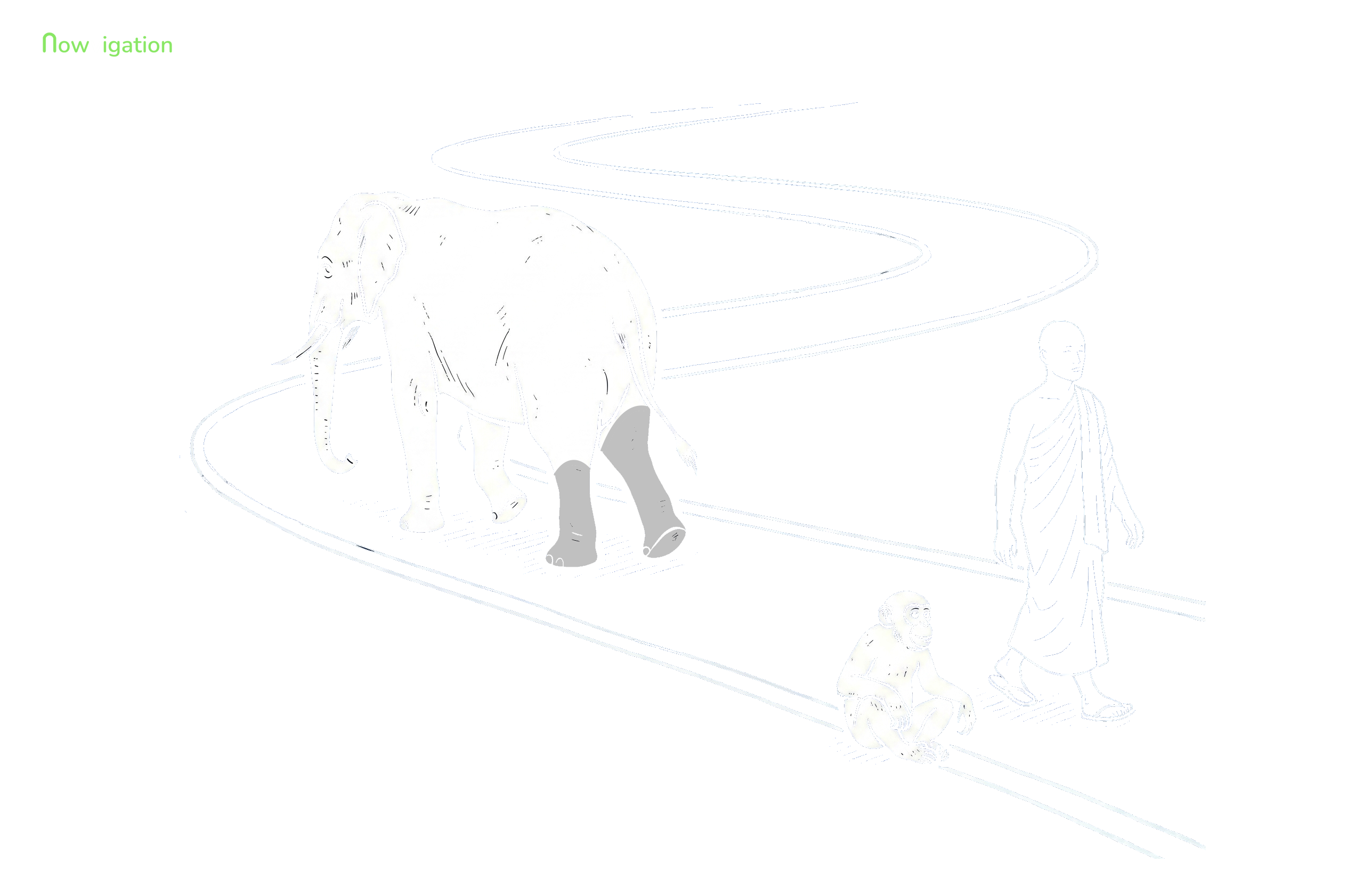
The seventh painting shows the next achievement: the monkey leaves the elephant. Thoughts, which had accompanied us throughout the journey - ahead of the elephant, behind it, holding on to its tail - now sit apart, beside the path. They are still there, but they are no longer part of the procession.
This is the seventh stage, which the tradition calls "Thoroughly Pacifying" (or in Tibetan English: Complete Pacification).
The Monkey That Departs
The monkey has accompanied us through all six previous paintings. In the first painting, he led the elephant. In the second, he yielded a little. In the fifth, he was already only holding on to the tail. In the sixth, he walked calmly behind the elephant.
Now, in the seventh painting, he has left.
What does this mean? The practitioner has reached a level at which thoughts are no longer drawn into the elephant - they sit aside. Thoughts still arise, but they no longer cling to the mind. They pass through attention like clouds across the sky, without disturbing it.
This is deep pacification. Not only stability, not only clarity, but a natural separation between thoughts and attention.
The Hind Legs That Are Still Grey
Notice the elephant's hind legs - they are still grey. Most of the body is entirely white, but traces remain.
The tradition explains this precisely: even at the seventh stage, very subtle traces of laxity can still arise. Rare moments of dullness. A passing sense of heaviness. But all of this can be dispersed with the slightest effort. The hook is no longer needed. The rope is no longer needed. A light touch of attention is enough to restore clarity.
The Monk Who Has Returned to Walking Behind
A telling detail in the painting: the monk has returned to walking behind the elephant. In the fifth and sixth paintings he walked ahead and led. Now he walks behind it, without a rope and without a hook.
The tradition explains this position: the monk being behind means that the practitioner allows the mind to rest naturally. Concentration arises of its own accord, immediately, without effort. But - the monk is still watching. He is not asleep. He has not turned his gaze away. Subtle traces of laxity and distraction can still arise, and when they do - the slightest effort is enough to disperse them.
This is one of the most delicate moments of the journey: the mind already knows the way on its own, but the practitioner does not abandon his post. He is present, watching, and ready.
Why This Matters Even for a Beginner
This article describes a very advanced stage. Most practitioners - even those with years of experience - never reach it. So why read?
For one important reason: to see the whole map. Even if we are still at the first or second painting, it matters to know where the road leads. That there is an end to gross distraction. That there is an end to subtle dullness. That there is a stage at which even thoughts leave the mind and sit aside.
This is also an important reminder: the reason we work on the early stages is precisely so that we can reach these later ones. Recognising the traps, using the training wheels, daily practice - all of these are the foundation upon which the later stages are built. Every sitting at the first or second stage is a brick in the structure that ultimately leads to the seventh.
The next article in the series deals with the eighth painting - the stage at which the monkey disappears entirely, and the elephant becomes wholly white.
Want to start practicing concentration with real-time feedback and identify which stage you are in? Download Nowvigation and begin your journey.