
From Concentration to Insight: How the Thumb Movement Prepares You for Real Vipassana
The connection between the Buddha's Eightfold Path and your phone screen
The Scene That Caught Me Years Ago
I was sitting in a meditation retreat with a decade of practice behind me. My body was relaxed, my breathing was slow, and my thoughts were quiet. I felt I was "in a good place."
The teacher, who had been silent through most of the practice session, suddenly said: notice that we are fully awake, present in complete awareness.
In an instant I returned to focus and realized I had not really been there in the previous minutes. I had been certain that if my thoughts were quiet and my body felt pleasantly relaxed, I was doing meditation the way it was supposed to be done. In reality, I was in a state many meditators meet early in the path, and sometimes not only early: the Rabbit Trap, the pleasant fog that masquerades as depth.
That moment explained why I had felt so much resistance to Vipassana practice, which asks the practitioner to work more actively. This does not align with much of the meditation language popular today: "relax," "let go," "let thoughts pass." That is exactly what I had done, too well. I had turned practice into surrender, not right effort.
The problem is that this was never the Buddha's intention. This article is an attempt to restore to practice what many of us lost along the way, and to show why a small thumb movement on a phone screen can point back to the heart of the original training.
What the Buddha Actually Said About Practice
2,500 years ago in northern India, Siddhartha Gautama, who would become the Buddha, taught what he called the Noble Eightfold Path. It was not a religious slogan. It was a practical training program made of eight components that work together.
When people talk about Buddhist meditation, they usually mention two of them: Right Concentration, samma samadhi, and Right Mindfulness, samma sati. But the Buddha placed another component beside them, one that matters deeply for meditation practice: Right Effort, samma vayama.
When the Buddha designed the full training program, he did not stop at "concentrate." He required practice to be accompanied by right effort, because consciousness without action and without effort tends to sink.
Right Effort - The Limb Everyone Forgot
The Buddha defined right effort along four axes:
- Prevent harmful mental states that have not yet arisen.
- Abandon harmful mental states that have already arisen.
- Cultivate beneficial mental states that have not yet arisen.
- Strengthen beneficial mental states that already exist.
This is not surrender. This is not mere relaxation. This is work.
"Meditation is not evasion; it is a serene encounter with reality."
Thich Nhat Hanh, The Miracle of Mindfulness
"Meditation is a balancing act between attention and relaxation."
B. Alan Wallace, The Attention Revolution
That balance demands right effort, not the abandonment of effort.
The Satipatthana Sutta - The Buddha's Practical Meditation Instruction
If we want to see how the Buddha taught meditation in practice, we go to the Satipatthana Sutta, the Discourse on the Four Foundations of Mindfulness, MN 10. When you read it carefully, a surprising thing appears: much of the sutta is made of action instructions.
"There is the case where a monk - having gone to the wilderness, to the shade of a tree, or to an empty building - sits down folding his legs crosswise, holding his body erect and setting mindfulness to the fore. Always mindful, he breathes in; mindful he breathes out."
Satipatthana Sutta (MN 10), translated by Thanissaro Bhikkhu
Notice the verbs: sits, holds, sets, breathes, discerns. Each one is active. Each one requires effort. Then the Buddha continues with walking, standing, sitting, lying down, and scanning the body.
"When walking, the monk discerns, 'I am walking.' When standing, he discerns, 'I am standing.' When sitting, he discerns, 'I am sitting.' When lying down, he discerns, 'I am lying down.'"
Satipatthana Sutta (MN 10), translated by Thanissaro Bhikkhu
To advanced practitioners, this is clear: body scan in Vipassana is not passive observation. It is active navigation of attention. Remember the name of the app? Nowvigation. Navigation, in the present. This was not an accident.
Two Types of Meditation, One Goal
The Buddhist tradition distinguishes between two main families of practice. Samatha is concentration practice. Its goal is stability of mind: the ability to hold attention on one point over time. The classical tool is the breath.
Vipassana is insight practice. Its goal is to see reality as it is, to investigate inner phenomena, and to understand directly impermanence, non-self, and suffering.
Many modern teachers present these as separate practices, but Vipassana without Samatha is nearly impossible. To see clearly, the mind must first become stable. The Buddha said this directly in the Samadhi Sutta:
"Develop concentration, monks. One who is concentrated sees things as they really are."
Samadhi Sutta (SN 22.5)
The Transition from Concentration to Insight
Imagine the journey. You begin with concentration practice on the breath. After months or years, you achieve reasonable stability. Then the teacher says: now move to body scan. Move attention deliberately from the head to the shoulders, from the shoulders to the arms, from the arms to the fingers. Notice every sensation that arises.
And suddenly, meditation is no longer fun. The practitioner who was stable on the breath discovers that they now need to move attention deliberately. Apps often teach us to listen to instructions. They do not always teach us to navigate consciousness. When the time comes to transition into real Vipassana, we discover a muscle we have not developed.
It is like learning to stand steadily on one leg, and then being asked to dance. The transition from listening to insight requires the ability to move attention deliberately, in a controlled way, from point to point.
Why the Thumb Movement Is Exactly What the Buddha Would Have Recommended
The Buddha required meditation practice to include right effort: active, precise, coordinated effort that does not become escape. The Satipatthana Sutta shows how this looks in practice: deliberate movement of attention from point to point.
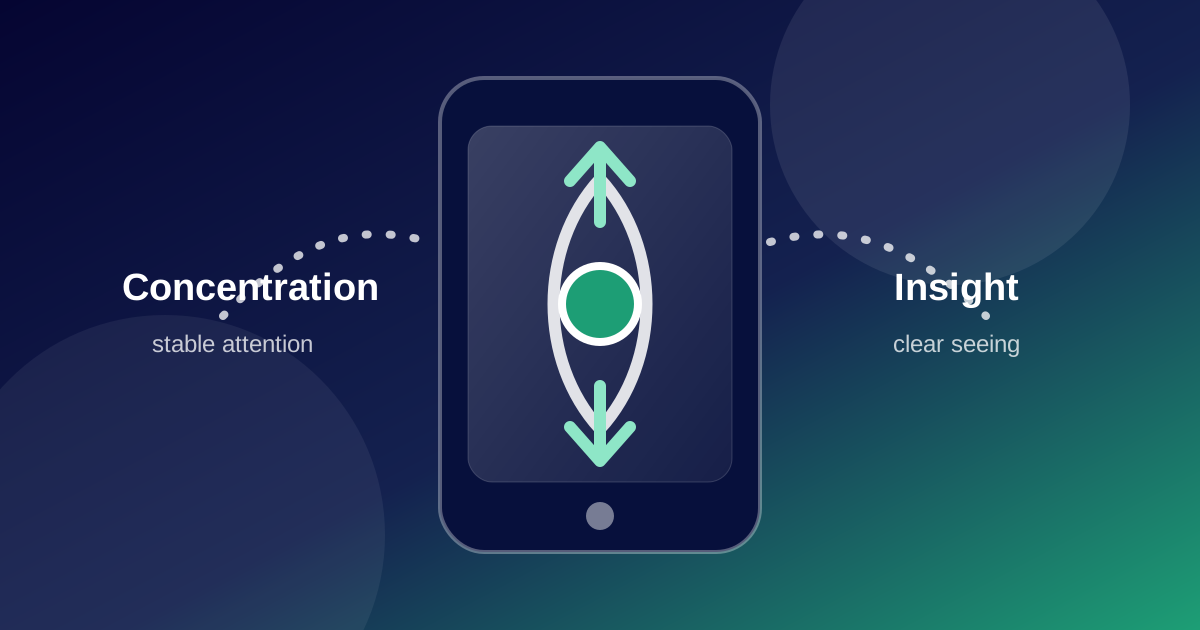
Now look at the thumb movement in Nowvigation:
- It demands action. The thumb does not move by itself. You move it.
- It demands effort: precise effort, not excessive effort.
- It blocks passivity. When attention scatters, the thumb gives you away.
The thumb movement is a modern translation of right effort in meditation. This does not mean there is no place for concentration practice without movement. It means the thumb can serve as training wheels that help us reach higher concentration until we no longer need the movement.
From Thumb to Body Scan - A Natural Transition to Vipassana
The skill built through thumb practice is the same skill needed for Vipassana. In thumb practice you learn to move something in coordination with the breath, track attention in real time, notice when attention drifts, work with a sequence of movement, and build active navigation of attention.
In Vipassana, you move attention itself from area to area, track inner experience in real time, notice when attention drifts, work with a continuous scan, and navigate attention through bodily experience.
It is the same structure. Instead of moving a physical thumb, you move virtual attention. That is why Nowvigation practitioners who later move into Vipassana often discover that they already know the work. They do not arrive with a missing muscle. They arrive trained.
What You Actually Build When You Move the Thumb
You build right effort. Not too much and not too little. If you let go, the thumb stops. The tool forces you to calibrate effort gently.
You build attentional navigation. Every inhale and exhale becomes a small exercise in moving attention in a controlled state.
You build resistance to dullness. The rabbit cannot sneak in while the thumb is moving. Over time, you also learn to recognize dullness without the app.
You build a foundation for Vipassana. When you later move to body scan, feelings, and investigation of inner phenomena, the transition flows more naturally.
You build independence. Eventually the thumb comes off. The breath remains. Deliberate movement of attention remains. Right effort remains. Only the training wheels come off.
Summary - What to Take Home
- The Buddha did not teach passive practice. He taught active, precise practice.
- The Satipatthana Sutta is a training program in mental navigation.
- Many practitioners build the ability to hold attention, but not to move it.
- The thumb movement is a modern application of concentration and right effort.
- Nowvigation can help build the foundation for real Vipassana.
The app I created was not born from an intention to bridge Samatha and Vipassana. But after intensive work with it, this is what I discovered it does. As far as I know, it is a rare digital tool that intentionally builds this bridge.
Ready to Begin?
If you recognized the pleasant fog of the Rabbit Trap, or if you have felt resistance to the transition into Vipassana practice, start by locating where you are in the path or by practicing with Nowvigation.
Take the 12-question diagnostic quiz, or download Nowvigation and begin building the foundation for both concentration and insight.