
The Nine Stages of Concentration - Painting Two: When the Elephant Starts to Listen
Article Series | Article 2 of 9 | Estimated reading time: 7 minutes
Remember the first painting? The monk running behind, the elephant running in the middle, and the monkey running ahead and leading them all. All of them completely black, all of them fleeing forward.
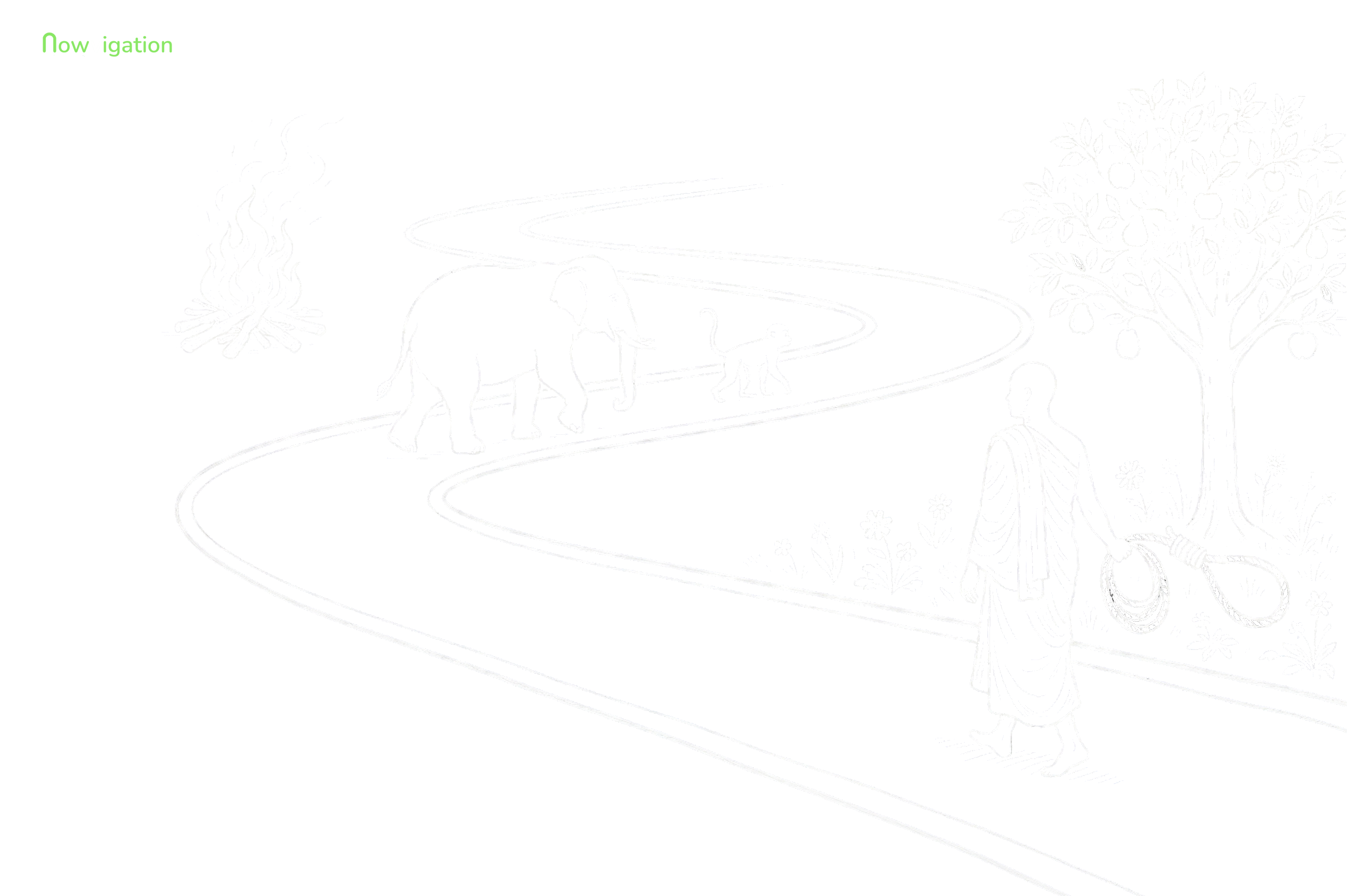
The second painting looks almost identical - the same scene, the same figures, the same landscape. But there are two small changes that change everything: the elephant's head has slightly whitened. The monkey's head has slightly whitened.
It looks like a tiny detail. In fact, it is the meditator's first victory.
What Happened Between the First Painting and the Second?
In the first painting, the meditator had just begun. He heard a teaching on meditation, read a book, maybe watched a video - and decided to try. The force that drove him is called in the Tibetan Shamatha tradition (also known as Samatha in the Pali tradition) the Power of Hearing (śrūtabala) - the power of learning from someone else.
In the second painting, something has shifted. The meditator didn't just hear - he began to contemplate. He returned to himself again and again, to the instructions he received, memorized them, thought about them, tried to understand them. The force driving him now is called the Power of Contemplation (cintābala).
This difference is the difference between someone who once read about swimming, and someone who is already in the water, feeling how water actually works.
The Whitening of the Head - What Does It Actually Mean?
The most interesting point in the second painting is that the whiteness begins specifically in the head - of both the elephant and the monkey. Not in the body, not in the legs. In the head.
Let's break this down:
The Elephant's White Head - Attention Begins to Rest on the Object
In the first stage, we tried to pay attention to the breath and within three seconds we were already somewhere else. Now, in the second stage, something has changed: we manage to stay with the breath for a few seconds longer before our attention escapes. Not much - maybe ten, twenty seconds. But there is progress.
This is what the tradition calls "Continuous Attention" (Sanskrit: samsthāpana; also rendered as Continual Placement in some Samatha teachings) - the second stage. Attention still escapes, but it escapes less. This is the meaning of the elephant's white head.
The Monkey's White Head - Thoughts Begin to Calm
The monkey - meaning the thoughts - has also begun to whiten at the head. For the first time in one's practice life, there are moments when there is no flood of thoughts. It's not that thoughts have disappeared completely. They are still there, they still pull the elephant. But there are small gaps between them. Intervals of silence.
The beginning meditator is usually astonished when this happens for the first time. "Wait, did I really not think about anything for five seconds?" Yes. It happened.
Why the Head, and Not the Body?
Good question. The traditional answer is that change in meditation always begins from the inside out - from the head to the body, from the center to the periphery.
The head is the place of reception of the object - the place where the meditator "holds" the breath, the mantra, or the object on which he is concentrating. When the head begins to purify, it is a sign that the object itself is beginning to stabilize in the mind.
In the following paintings we will see how the whiteness spreads - to the neck, to the back, to the legs, until ultimately the entire elephant will be completely white.
What Hasn't Changed - and Why That Matters
It's worth noticing what stayed the same from the first painting:
The monk is still behind - he is running, and he still hasn't caught up to the elephant.
The monkey still leads the elephant - thoughts are still in control.
The fire still burns strong - the effort required is still very great.
The fruit tree still tempts - the five senses still distract at every moment.
This is an important message of the second painting: progress is slow and subtle. This is not a stage where suddenly everything works out. This is a stage where a small part of the mind has begun to listen. A small part of the thoughts has begun to calm. That's all. And that's enough.
This Stage in Real Life - What Does It Feel Like?
Most meditators don't recognize this stage when it happens. They are waiting for a big experience, a dramatic "aha" moment. But the second stage is exactly the opposite - it is subtle, almost imperceptible.
How will you know you are in the second stage?
You are no longer frightened by thoughts - in the first stage, every thought felt like an explosion. Now you notice it, and return your attention - without drama.
You manage to hold your attention on the breath for a few seconds longer - not a few minutes. A few seconds. And that is a huge change.
There are moments of real silence - short, rare, but real. Silence that was not summoned and not guided from the outside by a guided visualization. It simply appeared.
You return to practice without anyone telling you to - practice is starting to be part of your day, not an external task.
Why Is It Important to Recognize This Stage?
Many beginning meditators give up exactly here. They expect a big jump, and they get a tiny shift. They think "I'm not making progress," when in fact they are exactly at the right stage.
The second painting says something very reassuring: the first change is always small. It begins from the head. It is not dramatic. But it is real, and it is the key to everything that follows.
If you give up here - you will miss the rest of the journey. If you continue - even without seeing a big change - you will reach the third stage. And the fourth. And so on.
The Nowvigation Method and the Second Stage
Right here, in the second stage, the Nowvigation tool becomes especially valuable. Why?
Because the second stage is the stage where the meditator needs accurate feedback to recognize his small progress. Without feedback, this progress feels as if it did not happen. As we advance through the stages of the course and manage to complete longer practices with less and less guidance, this is external progress that can be seen and felt long before we feel the internal progress.
The Nowvigation thumb mechanism was built for exactly this purpose - to give meditators a tangible anchor through which they can progress confidently in very small steps. With less and less guidance, with less calming music - just you, the breath, and the thumb.
Three Takeaways
1. The first progress always begins from the head - not from the body, not from emotion. The elephant's head whitens first because that is where the change of consciousness begins.
2. The stage of contemplation is greater than the power of hearing - it is not enough to hear about meditation. One must contemplate, repeat, memorize the instructions for ourselves, until they begin to become a skill.
3. Real change is slow and subtle - if you waited for a dramatic jump and didn't get one - you are probably already in the second stage. You just didn't recognize it.
The next article in the series deals with the third painting - the moment when the monk manages for the first time to throw the rope and catch the elephant.
Further reading: in the book "Pointing Out the Great Way" by Dan Brown, Wisdom Publications, one can find a detailed description of the nine stages of Shamatha (also spelled Samatha) according to the writings of Je Tsongkhapa.
Want to start practicing concentration with real-time feedback and identify which stage you are in? Download Nowvigation and begin your journey.