
Nine Stages of Focus - The Ancient Map That Teaches Us to Control Our Mind Alone
Article Series | Article 1 of 9 | Estimated reading time: 7 minutes
Most of us learned meditation with someone guiding us - a voice in a recording, relaxing music, an app telling us what to do. It feels nice. But there is one problem: the moment the guidance ends - the elephant runs free again. We need to learn to control our own elephant - while right now it is probably an app or some instructor doing the guiding for us. These ancient paintings, 1,500 years old, show exactly how to do that.
About This Series
This is the first article in a series about the ancient Buddhist painting system known as "the elephant path" - The philosophy is 1,500 years old, and we will try to break it down and simplify it into plain everyday language.
The series is suitable both for those just beginning to explore meditation, and for experienced practitioners who want to understand what is actually happening during practice.
Introduction - A Picture Is Worth More Than a Thousand Words
About 1,500 years ago, around the 4th century CE, the great Buddhist monk Asanga composed the doctrine of "shamatha" - the doctrine of training the mind to focus. Later, around the 11th to 12th century, the great Tibetan teacher Je Tsongkapa organized these teachings into a complete map of nine stages. And someone brilliant decided to paint that map.
The paintings shown here are the product of a modern adaptation of traditional Tibetan wall paintings known as "thangka" - sacred paintings on cloth created for teaching and practice. The original paintings, likely first created as wall murals in monasteries around the 19th century, illustrate the nine stages of "shamatha" - the practitioner's journey toward a quiet and focused mind.
Here at Nowvigation, we preserved the monk and most of the original symbols - but used a very simple drawing style, and made the paintings cleaner and easier to understand. Not to replace the source, but to open a door. Anyone interested is always welcome to dive into the sources cited at the end of this article.
The First Painting - When Our Mind Runs Ahead and We Run After It
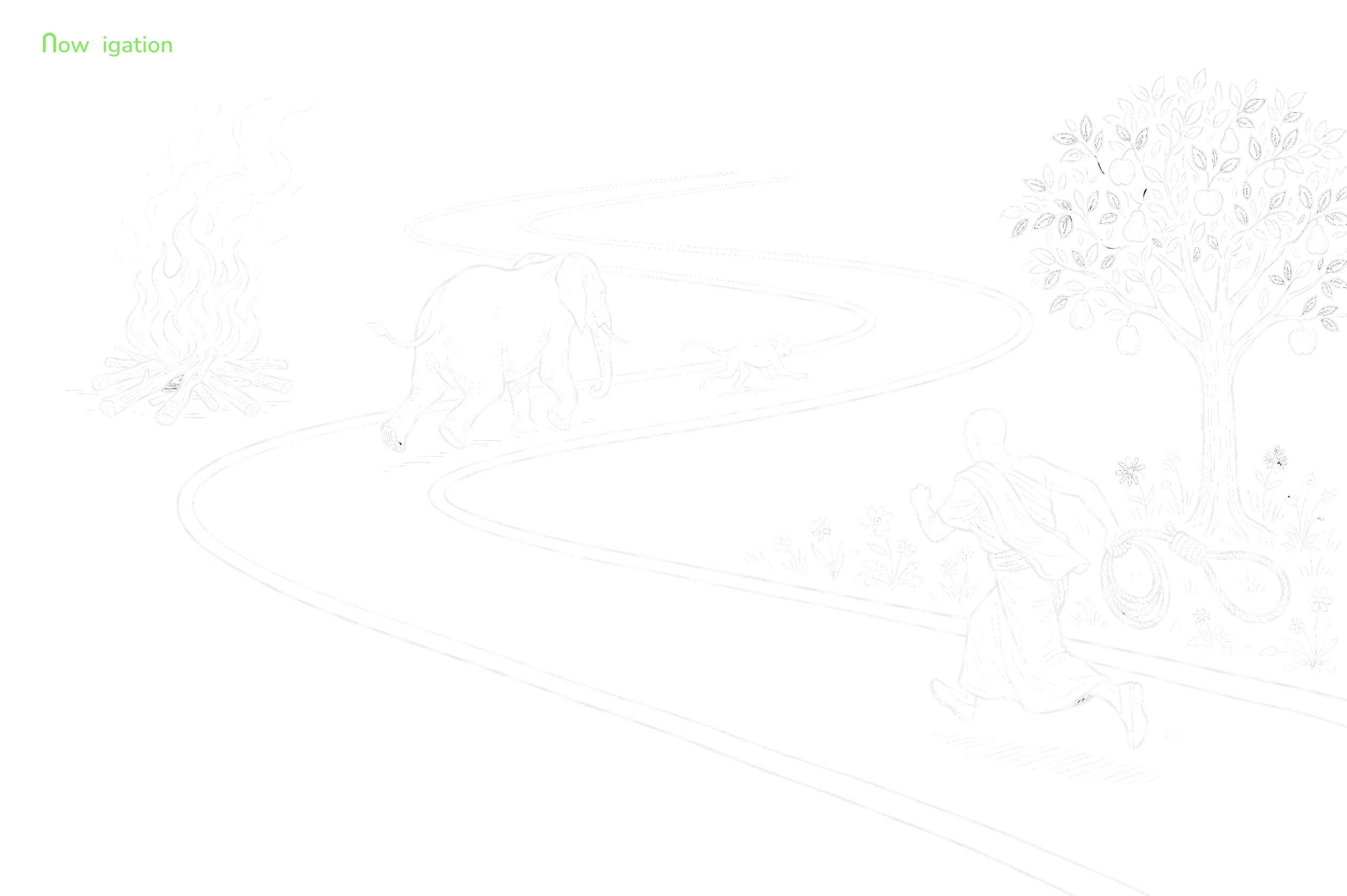
In the first painting, three figures appear: a monk, an elephant, and a monkey. The monk is behind. The elephant is in the middle. And the monkey is ahead of them - forcing everyone to run and keep up with the fast pace.
This is us on a regular day.
Let's look at what each figure symbolizes:
The Elephant - Our Mind
The elephant is the mind - our consciousness in its rawest form. Why an elephant? Because the elephant is one of the most powerful animals in nature. If it is wild - it is dangerous to everyone around it. If it is trained - it can accomplish any task asked of it, no matter how difficult.
Our mind is exactly like this. An untrained mind causes harm - to ourselves and others. All the suffering we experience, according to Buddhist understanding, is caused by the untrained mind. A trained mind, on the other hand - there is no limit to what it can achieve.
There is another point worth noting: the elephant's footprint is the largest in the animal kingdom. So too is the impact of our mind on our lives. Everything we do, say, and feel - it all originates first in the mind. The body and speech are merely its messengers.
In the first painting, the elephant is dark. The dark color symbolizes the "heaviness" of the mind - laziness, fog, stagnation. Not that our mind is bad. It is simply not yet trained.
The Monkey - Our Thoughts
The monkey is also dark, and leads the elephant. This is no coincidence. The monkey symbolizes the incessant thoughts - the emotional leaps, the inner dialogues, the worries, the distractions.
Have you ever noticed that sometimes we don't "decide" to worry? The worry simply begins, and drags the entire mind along with it. That is the monkey leading the elephant. Thoughts lead consciousness, not the other way around.
Here lies one of the deepest messages the Buddha conveyed: "I am not my thoughts."
The painting illustrates this brilliantly: there are three separate entities here - the monk, who is us as observers; the elephant, which is consciousness; and the monkey, which is thoughts. If the three are separate - then thought control is possible, and we don't have to be dragged along by every thought that arises. There is a possible distance. And distance is freedom.
The Monk - The Practitioner
The monk is us. And at the first stage - he is behind. He runs, he tries, but the elephant has already gone far and isn't really listening.
Anyone who has tried to sit and breathe for a minute, only to discover that within 10 seconds they're already thinking about tomorrow's shopping - knows this monk well.
In the monk's hands are two tools:
The rope - symbolizes memory and mindfulness. The ability to remember that we are supposed to be here, now, on the breath. No self-criticism, no drama - just remembering.
The loop knot on the rope symbolizes alertness. Not just "remembering" but also paying attention: what is happening now? Where did the mind go?
These two tools - memory and alertness - are the foundation of all meditation. They are not a talent we either have or don't have. They are muscles that strengthen with consistent attention training. Just as we practice in the app with the thumb principle - the idea is not to wait for the mind to calm down on its own, but to give it a measurable, practical tool for training.
Note: In the original painting, the monk holds a hook in his hand. In our modern version, we chose to use the loop knot on the rope to simplify the illustration and focus the message. Anyone interested in seeing the full details is welcome to examine the original painting.
The Fire - Our Energy
On the left side of the painting, a bonfire burns. The fire symbolizes effort and enthusiasm from practice - the genuine desire to change without which no journey begins.
Notice a small but significant detail: throughout the nine paintings, the fire gradually diminishes. Not because practice becomes less important, but because the required effort decreases. At first, great effort is needed to maintain focus. At the end of the path - things happen naturally, on their own.
The Fruit Tree and Flowers - Our Five Senses
On the right side stands a tree laden with fruit. Beneath it, flowers. Beautiful, right? Yes - and that is exactly the problem.
The tree with its fruit, the flowers beneath it, and in the sources also additional objects like cloth, a perfume conch, and cymbals - all these symbolize the five senses and everything they offer: smell, taste, touch, hearing, sight. The beautiful distractions of life. At the first stage of practice, every small thing distracts us - noise from outside, a small pain in the knee, a smell from the kitchen.
This is not a weakness. It is simply the starting state. We are all there at the beginning.
What Makes This Painting Special
We said "a picture is worth more than a thousand words" - and in this painting, it is especially true.
The entire psychology of meditation is described here in one simple scene: a monk chasing an elephant that a monkey leads. No need for complex theories. The painting says everything.
And what is especially moving - the painting does not judge. The monk has not failed. He is simply at the beginning of the path. And there are eight more paintings.
In the following paintings, we will see how the elephant gradually becomes white, the monkey grows smaller until it disappears entirely, and the monk - who at first ran behind - slowly walks ahead of them, and in the end, rides.
Guided Meditation vs. Independent Meditation - What Is the Real Difference?
Notice the painting: no one is guiding the monk. There is no voice in the background telling him what to imagine, and no music calming the elephant for him. The monk learns to do it alone - with the rope and the loop knot, meaning with memory and alertness. This is exactly the distinction between meditation that becomes a real skill, and meditation that depends on external conditions. Guided meditation is a good starting point - but it is not the destination. The destination is to control our own elephant, alone. At Nowvigation, a meditation school built on these principles, we built the tool that helps you learn independent meditation exactly this way.
Why Learn Independent Meditation - Four Points to Take Home
1. The mind is like an elephant - strong, powerful, and not inherently bad. It simply needs training. And training is possible.
2. We are not our thoughts - the monk, the elephant, and the monkey are three separate entities. The distance between them is our space of freedom.
3. At the beginning of the path - we are all behind - this is not failure, it is the first stage. And there are eight more.
4. Guided meditation is training wheels - just as a child learns to ride a bike with training wheels and eventually removes them, guided meditation is a starting point - not a destination. The goal is to control the elephant and the monkey alone, in any situation and at any time.
The next article in the series covers the second painting - the stage where the elephant first begins to hear the monk.
For those who want to dive into the full sources: the writings of Je Tsongkapa are the primary source. In English, the book "Pointing Out the Great Way" by Dan Brown, published by Wisdom Publications, is a helpful resource.
Want to start practicing focus with real-time feedback? Download Nowvigation and begin your journey.