
The Nine Stages of Concentration - The Eighth Painting: When Only an Initial Pointing Is Needed
Article series | Article 8 of 9 | Estimated reading time: 4 minutes
Remember the seventh painting? The monkey had left the elephant. Thoughts sat aside. The monk had returned to walking behind, allowing the mind to rest naturally.
The eighth painting shows the next achievement: the elephant is entirely white. The monkey has gone. And the monk is once again walking ahead of the elephant - this time only to point.
This is the eighth stage, which the tradition calls "Making Single-Pointed". It is almost the end of the road, the stage just before Shamatha itself.
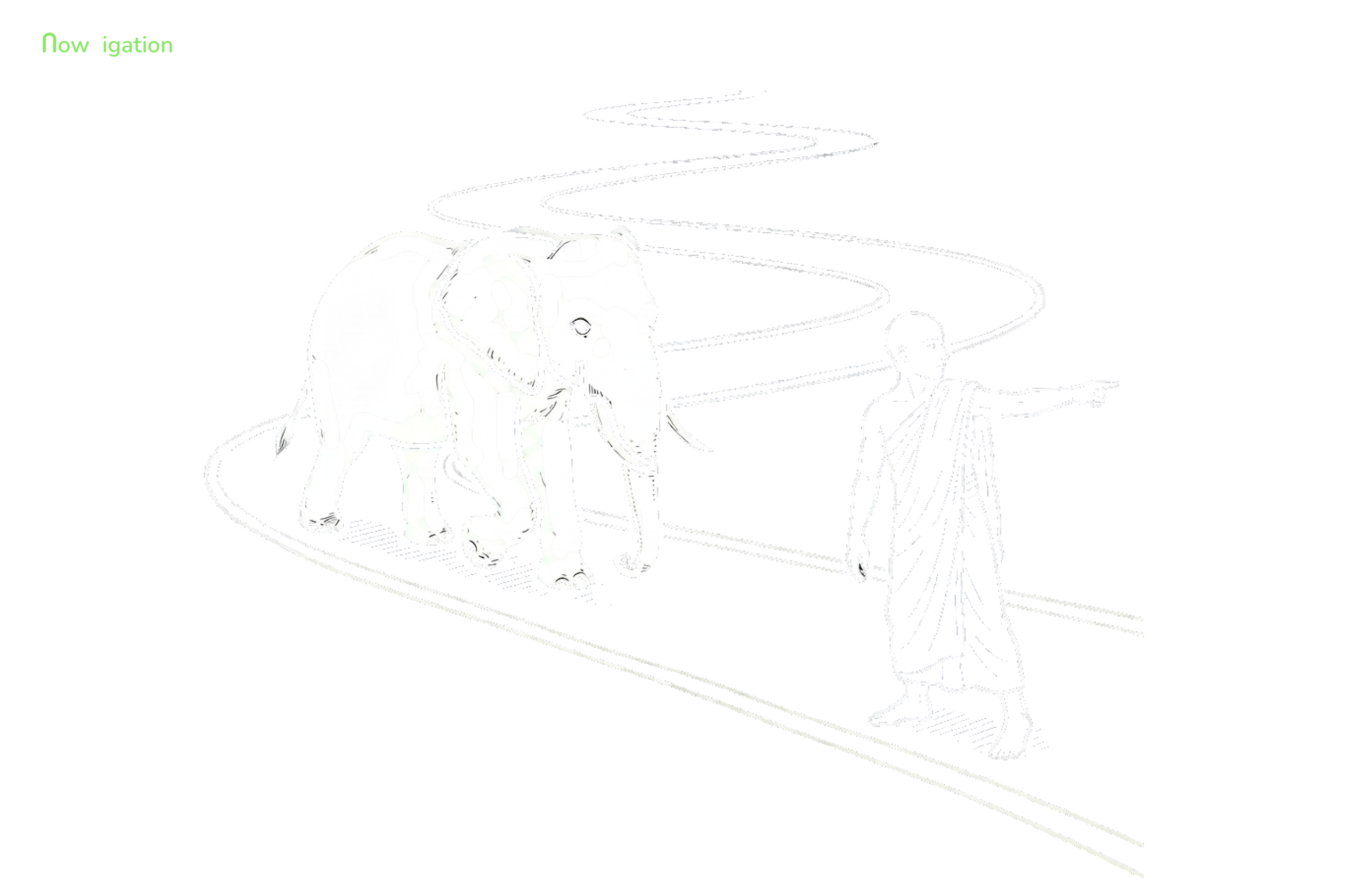
The Wholly White Elephant
Remember the elephant's grey hind legs in the seventh painting? They have gone. The elephant is now entirely white, from the tip of its ear to the sole of its hind foot.
What does this mean? The tradition is clear: the mind can now remain in continuous absorption upon the object of concentration. No more traces of laxity. No more traces of dullness. No more traces of distraction. The stillness is absolute and unbroken.
This is an attainment that every Buddhist practitioner aspires to throughout the entire journey. This is "Single-pointedness of mind" - the ability to hold a single point in complete continuity, without interruption and without fading.
The Monkey That Has Disappeared
The monkey has accompanied us through seven paintings. Now, at the eighth stage, he no longer exists. Thoughts are not merely "sitting aside" as at the seventh stage - they no longer arise. The mind is empty of thoughts, and yet it is not asleep. It is fully awake, clear, and still.
This is a description of an experience hard to imagine from the outside: a mind awake without thoughts. Most people alternate between two states - thinking while awake, or quiet while drowsy. At the eighth stage there is a third: stillness with full clarity.
The Pointing Monk
Now the most telling detail in the painting: the monk stands ahead of the elephant and points to it. He is not touching it. He is not holding it. He is only pointing.
The tradition explains this gesture precisely: at the eighth stage, the practitioner needs only a small effort at the beginning of the session for concentration to settle into place. After that initial effort - the elephant walks on its own. There is no need to bring attention back. There is no need to follow. The initial pointing is enough.
It is like someone lighting a paraffin stove: a small effort at the start to ignite it, and then the flame burns on its own. At the eighth stage, the practitioner "ignites" concentration in the very first moment of the sitting, and from there it carries on of its own accord, undisturbed, until the sitting ends.
Why This Matters Even for Beginners
This article describes a near-final stage. Most practitioners will never reach it. So why read?
For one important reason: to see that the journey does, in fact, come to an end. Most new practitioners experience the practice as something endless - a never-ending struggle with thoughts, traps that won't unravel, dullness that always returns. The eighth painting reminds us: there is an end. This stage tells us that the goal is real, attainable, and capable of being described.
It is also a reminder about the nature of effort in meditation: even at the early stages, effort is measured by the initial ignition, not by continuous work. We do not need to "work" throughout the entire sitting. We need to set attention well at the start, and then let it be.
The next article, the last in the series, deals with the ninth painting - the final stage, Shamatha (Calm Abiding), in which the monk sits beside the elephant in complete serenity.
Want to start practicing concentration with real-time feedback and identify which stage you are in? Download Nowvigation and begin your journey.