
The Nine Stages of Concentration - The Fifth Painting: When the Practitioner Begins to Lead
Article series | Article 5 of 9 | Estimated reading time: 8 minutes
Remember the fourth painting? The monkey had lost its grip, the elephant had turned almost entirely white, and the monk had drawn closer to the elephant than ever before. For the first time in the journey, the elephant no longer trailed after the monkey.
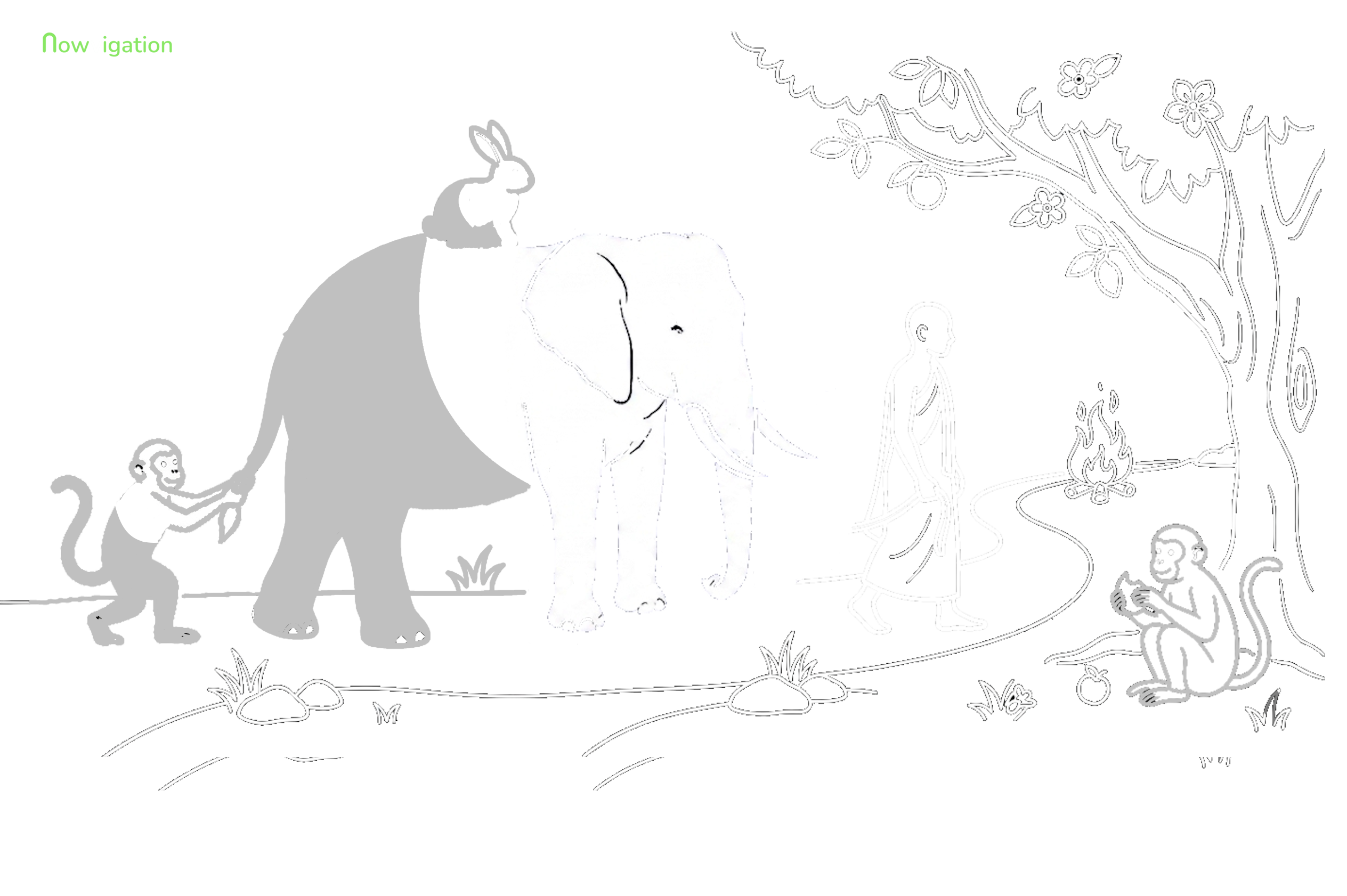
The fifth painting shows a revolutionary moment: for the first time in the journey, the monk walks ahead of the elephant. He no longer chases it. He no longer climbs alongside it. He leads it. The monkey, which only two paintings ago dominated the entire journey, is now behind, holding the very tip of the elephant's tail in one last attempt to spur it on.
This is the moment the Tibetan tradition calls "Taming" (or in Tibetan English: Disciplined Setting). It is the fifth stage of the Shamatha journey, and it marks a meaningful shift in the power that drives the practice.
The New Power - The Power of Awareness
The first four stages of the journey were governed by the Power of Mindfulness - the ability to remember and to bring attention back. Now, at the fifth stage, a new power joins in: the Power of Clear Comprehension (or in plainer English: the Power of Awareness).
What is the difference?
Mindfulness is remembering to bring attention back when it has wandered off. Awareness is something else entirely: it is the ability to perceive the quality of attention at every moment. Not waiting for attention to escape, but constantly checking: how alive is it? How alert is it? How clear is it?
It's similar to the difference between a guard who only wakes when a burglar breaks in, and a guard who walks the rounds and checks all the time. The second guard is far more effective, because he prevents the break-in before it happens.
At the fifth stage, the practitioner develops this very ability. That is why he can lead the elephant - he sees what lies ahead, rather than reacting to what has already passed.
The Monk Who Walks Ahead of the Elephant - What Does That Mean in Practice?
This is the most dramatic visual change in the series so far. Up until the fourth painting, the monk walked behind - trying to catch up, holding the rope from behind, trying to gain control. In the fifth painting, he is in front of the elephant.
What does this mean in practice?
It means the practitioner no longer reacts to the mind. He leads it. Instead of waiting for the breath to escape and then bringing it back, he guides attention proactively. He knows when to strengthen concentration and when to ease off. He knows when to check alertness and when to let go.
According to tradition, at this stage the practitioner can sustain steady concentration for more than half an hour without interruption. At the fourth stage the limit was around fifteen minutes. This is now a long, stable, mature practice.
The Monkey Holding the Tail - Remnants of Distraction
Notice the monkey in the painting. It is now behind the elephant, and yet - it is still there, and still holding the very tip of the elephant's tail.
This is a precise symbol of what happens in practice at the fifth stage. Gross distraction has gone. The strong thoughts, the long stretches of being carried away, the stories that hold the mind for minutes on end - all of these no longer trouble us. But remnants of distraction are still there.
A brief thought will arise. A sound will pull us aside for a moment. A bodily sensation will draw attention. The monkey is still trying - but he is weak, and he is behind.
This is a fundamental shift from stages 1-3, in which the monkey led the elephant. Now the situation has completely reversed. The practitioner leads. The elephant follows calmly behind. The monkey, the symbol of distraction, is the tail - not the head.
The Second Monkey Sitting Alone Beneath the Fruit Tree
In this painting, a new detail appears that was not there before: a second monkey, sitting alone beneath the fruit tree, eating. He doesn't cling to the elephant. He doesn't run after it. He sits apart, enjoys a piece of fruit, and takes no interest in the journey of the elephant and the monk.
What does this mean?
The second monkey is also a symbol of distraction, but of a different and surprising kind: he represents even bright, virtuous thoughts about meditation and the Dharma (the Buddha's teaching). That is why the second monkey is painted white and not dark - he doesn't represent a bad thought, he represents a good one.
And even though the thought is good - it is still considered a distraction.
This is one of the deepest and most surprising lessons of the journey. The practitioner at the fifth stage is no longer troubled by worries, by planning, or by negative thoughts. But he begins to encounter a new kind of thinking - "pure" thoughts: "What a wonderful practice", "I'm progressing nicely", "Could this be Samadhi?", "I must remember this insight and tell my teacher about it."
These thoughts feel different. They don't feel like distraction. They feel like insight.
But they are still thoughts. And they still pull us away from the object. The white monkey sits beneath the fruit tree and enjoys a piece of fruit - sweet though it may be, it is not the breath. The tradition is unambiguous on this point: in Shamatha, even the finest thought is a distraction. Only later, in Vipassana (insight meditation), will there be a place for such thoughts. At this stage, they are still pulling us away.
The Rabbit Still Sitting on the Elephant
And still - the rabbit is there. He was in the third painting, in the fourth painting, and in the fifth painting he sits on the elephant's back exactly as before. He still hasn't gone.
Why?
Because at the fifth stage, the danger of dullness and loss of control is still present. The quieter the distractions, the deeper the calm, and even though the practitioner manages to sit through half an hour without interruption - the worry remains that the silence may turn into drowsiness.
The specific danger of the fifth stage differs from that of the fourth. At the fourth stage, the danger was Elation - holding too tightly. At the fifth stage, the danger is boredom and slackening. The practitioner manages to sit for a long time, he enjoys the quiet, and he loses his edge.
Tradition calls this "Subtle Sinking" or "Lack of Vivid Clarity". Attention is there, the breath is clear, but it has lost its sharpness. It is like a picture out of focus - you see, but you don't see crisply.
This is exactly what we call the Rabbit Trap.
The Fading Fire - Less Effort Required
In the early stages the fire blazed, vast and powerful. In every painting it has grown smaller. In the fifth painting, it is very small indeed.
The fire represents the effort required for practice. At the start, enormous effort is needed simply to sit. Later, effort is needed to bring attention back when it escapes. Now, at the fifth stage, the effort is minimal.
This doesn't mean the practice has become easy. It demands something else: subtle alertness. Less brute force, more sharpness. Less struggle, more attention to quality.
This is what experienced practitioners always try to explain to beginners: after years of practice, it doesn't become more powerful. It becomes finer.
What Hasn't Changed - And Still Matters
The fruit tree is still there. This means the five senses still exist. They no longer endanger us, but they have not disappeared.
The fifth stage is an enormous achievement, but it is not the end. There are still four paintings ahead.
This Stage in Real Life - What Does It Feel Like?
How will we know we are at the fifth stage?
We can sit through half an hour without interruption with steady concentration. The breath is clear. Thoughts still arise, but they are far away.
We are leading the practice rather than reacting to it. Instead of waiting for attention to escape, we notice in advance when it is weakening and we strengthen it before it has fled.
There is a sense of calm control. Not a tense vigilance, but a relaxed alertness. We know what we are doing.
And then comes the challenge: boredom. The practice becomes so steady, so pleasant, that the practitioner begins to lose interest and to be drawn into passivity. Concentration is there, but vitality fades. This is the specific danger of the fifth stage - not thoughts, not distraction, but the dwindling of enthusiasm.
The traditional remedy: to remind ourselves of the value of practice. To consider what deep practice gives us. To return to motivation. To rekindle the fire - even if it is small.
A practitioner who knows this painting understands: the pleasant quiet is not the goal. Calm is not concentration. The unbroken half hour is not Shamatha. The wisdom lies in remaining active and not being drawn into the honey trap of dim senses and passivity.
The Nowvigation Method and the Fifth Stage
At the fifth stage, the Nowvigation thumb mechanism continues to be a central tool - mainly in two ways:
First, it prevents drift into dullness. As the stage advances and the practice becomes easier, the risk grows that the practitioner will slip into a pleasant drowsiness. Moving the thumb in time with the breath demands continuous alertness. As long as the thumb is moving clearly and steadily, we are awake. If the rhythm grows blurred, that is a sign of the rabbit.
Second, it allows for subtle alertness. At this stage we don't need brute effort. We need fine attention to the quality of attention itself. The thumb is precisely the right tool for this - it is subtle enough not to interfere, and present enough to give continuous feedback on the state of the mind.
The principle of training wheels at Nowvigation fits this stage exactly. We don't take the wheels off yet. Only at stage 6, when the rabbit finally vanishes, can we let go of moving the thumb. At the fifth stage, the wheels are still needed, and they are still protecting us.
Three Points to Take Home
1. The fifth stage is the turning point to active leadership. The practitioner no longer chases attention, he leads it. A new power joins in - the Power of Awareness, the ability to perceive the quality of attention in real time.
2. The danger that the rabbit represents is still present - boredom, passivity, and dullness. Gross distraction has gone, and in its place comes a new challenge: the dwindling of enthusiasm and subtle haze. The pleasant quiet tempts us to give up sharpness.
3. This stage is an achievement, but not the goal. Building concentration is one of the milestones of the Noble Eightfold Path, and it lies in the second of the path's three groups. The second group speaks of concentration, while the third group speaks of the wisdom that grows out of that concentration. So this stage is indeed impressive, but four more stages still lie ahead, and each of them demands its own specific work of refinement.
The next article in the series deals with the sixth painting - the stage at which the rabbit finally disappears, and the practitioner no longer needs to fear subtle dullness.
For further reading: Jan Willis's article in Lion's Roar, "10 Steps to Tame the Elephant", offers a detailed account of the nine stages according to the Tibetan tradition. Geshe Rabten's writings, too, contain precise observations on the lengths of concentration possible at each stage.
Want to start practicing concentration with real-time feedback and identify which stage you are in? Download Nowvigation and begin your journey.