
The Nine Stages of Concentration - The Fourth Painting: When the Mind Is No Longer Pulled Along
Article series | Article 4 of 9 | Estimated reading time: 8 minutes
Remember the third painting? The rope wound around the elephant's head for the first time. The elephant and the monkey turned around. A small rabbit appeared on the elephant's back and taught us about the trap of subtle dullness.
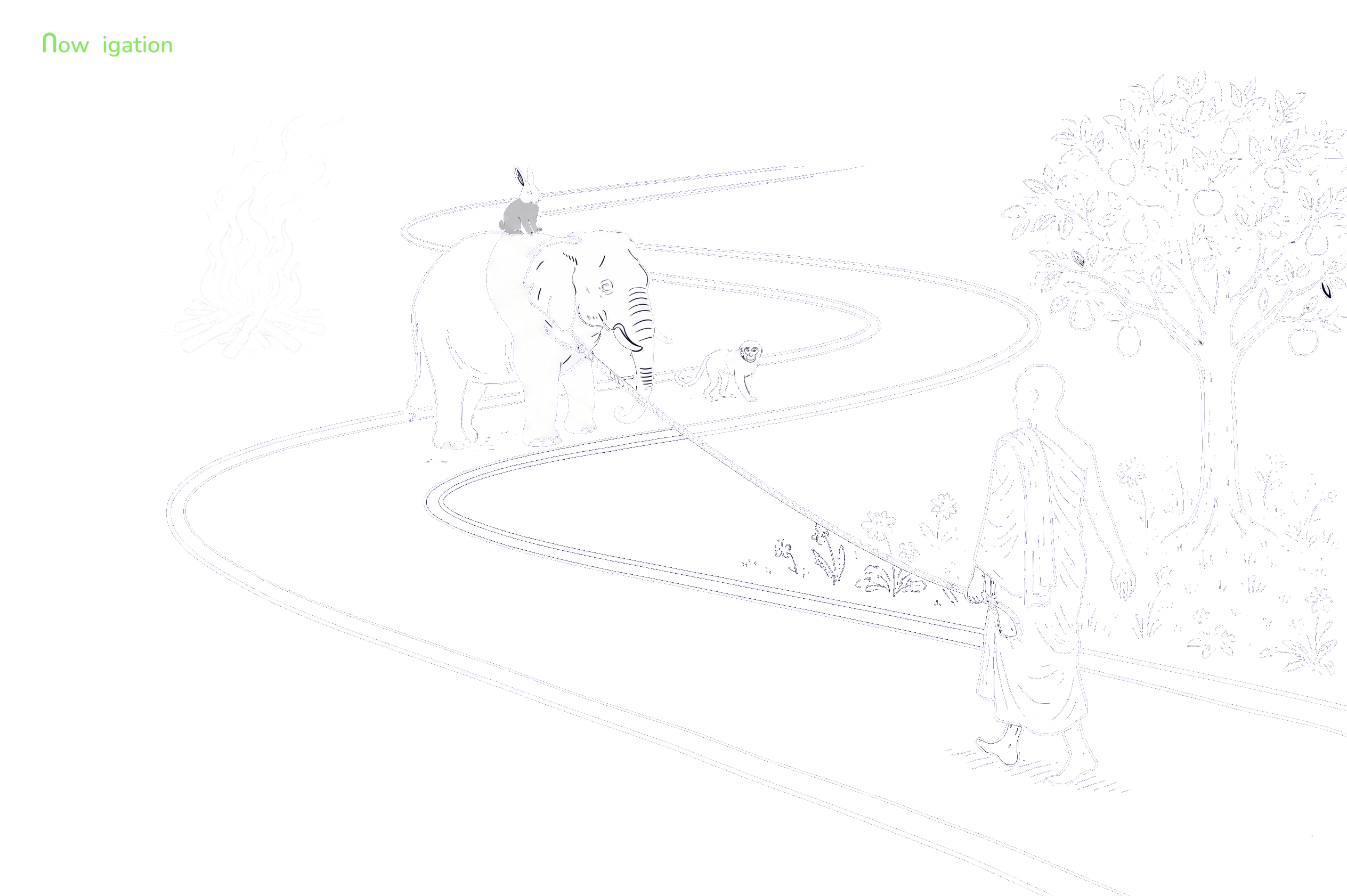
The fourth painting shows the first great achievement of the journey. The elephant no longer runs away. It walks at a steady pace. The monkey is still ahead of it, but it can no longer drag the elephant along behind. And the monk - closer than ever, the rope taut and stable.
This is the moment every practitioner waits for. A moment with a traditional name: "Close Placement". According to the Tibetan tradition, this is the closing stage of the first half of the journey - the stage of Stability.
What Happened Between the Third and Fourth Paintings?
The first four stages of the journey come in pairs. Stages 1-2 are reached through the Power of Hearing and the Power of Reflection. Stages 3-4 are reached through the Power of Mindfulness.
The difference between stage 3 and stage 4 is a difference of maturity.
In the third stage, the rope caught for the first time - we recognise the moment attention drifts and bring it back. This is a fresh achievement, still requiring effort.
In the fourth stage, the very same ability - but firmly established. Mindfulness is now so strong that the practitioner no longer loses the object of concentration. They may still wobble, still drift for brief moments - but they are always there.
The Tibetan tradition describes this with a beautiful image: the mind is like an eagle soaring high above its prey. It may drift a little to the left, a little to the right - but its gaze never leaves the prey for an instant. And so it is with our mind: it may wander a little, but never far from the breath.
This Stage Is an Achievement: Stability
The first four paintings in the series are all concerned with reaching Stability. The fourth painting marks the close of this part of the journey. The next paintings will deal with Clarity, and after that with Strength.
This is not an arbitrary division. It is a description of a real process.
Until now, our central question has been one and the same: "How do I keep from losing my attention?" We had flooding thoughts, subtle drowsiness, the lure of the senses. We worked hard to maintain our connection with the breath.
From the fourth painting onwards, the question changes: "How do we make the quality of our attention better?" Stability is already there. Now we are refining it.
This is a meaningful turning point in the journey, and it's worth pausing on.
The Monkey Loses Its Grip - What Does That Mean in Practice?
Notice the monkey in the painting. It's still there, ahead of the elephant - thoughts still arise. But the elephant doesn't run after it.
That is the key change. In paintings 1-2, the monkey pulled the elephant along. In painting 3, the two of them turned to look back. In painting 4, the monkey is still trying to pull, but the elephant no longer follows. It stands firm, moving forward at its own pace.
What does this mean in practical terms?
In the earlier stages, the moment a strong thought arose, it pulled us straight in. A worry about work, planning what to make for dinner, recalling an awkward conversation - and there we were, deep inside the thought.
In the fourth stage, something has shifted: thoughts still arise, but they no longer abduct us. We see them rising, and we choose not to follow. They pass in front of us, like background noise, while attention rests on the object.
Thoughts haven't disappeared - on that front, nothing has changed. What has changed is our relationship with them. They're still there, but they're no longer the ones in charge.
The White Elephant - The Body Learns to Follow the Head
Remember how, in the second painting, we said that change always begins from the inside out - from the head down through the body? Now we see this taking place.
The elephant's head - which began to lighten in the second painting - is now entirely white. The neck is white. The back is white. Most of the body is pale.
This is more than a graphic change. It is a precise description of what happens in the mind.
In the fourth stage, most of the mind is already settled and tamed. Most of the time, there is quiet. Most of the time, the breath is clear. But there are still residues - residues of laziness, of the wish to stop, of an old thought that surfaces every few minutes.
This is an important message: even at a relatively advanced stage, there is still work to do. And there are still five paintings to come.
The New Danger - Elation
Each stage carries its own dangers, and the fourth stage brings a new and surprising one: we hold the mind too tightly.
The tradition calls this "Elation". After three stages of struggling with distraction, after we've learned to catch attention and bring it back, we may arrive at the fourth stage and simply refuse to let go. We focus on the breath with enormous effort.
It's like a person who has learned to hold a bird in their hand. At first the bird flies away. Then they learn to catch it. And then, in their delight, they squeeze too hard - and the bird is crushed.
In the fourth stage, the challenge is to hold lightly. Attention that is steady, but not clenched. Alert, but not strained. This is the grip of a mature practitioner - a grip that knows how to release.
And even so - the rabbit is still there.
The Rabbit That Won't Leave
This may be the most important message of the fourth painting. In the third painting, the small rabbit appeared as a symbol of subtle dullness. In the fourth painting, it's still there. And in the fifth painting it will still be there. Only in the sixth painting will it finally vanish.
Why does this matter so much?
Because the monkey is small and relatively weak, the thoughts have settled. The elephant is steady. The quiet is deep. Everything feels excellent.
And precisely there, the rabbit grows stronger.
The quieter the thoughts, the greater the risk that alertness will fade and we will fall into a subtle drowsiness. The deeper the calm, the stronger the wish to remain in passivity, which sometimes drifts into pleasant haze.
The rabbit doesn't leave at this stage because it is a constant reminder: calm is not concentration. Calm is not alertness. Calm is not insight.
A practitioner at the fourth stage who doesn't know about the rabbit may sit for half an hour in a pleasant but foggy state and believe they have done deep meditation. In reality, they have been sleeping with their eyes open.
This is exactly what we call the Rabbit Trap, and it's the reason most practitioners get stuck for years at the same stage, without understanding why they aren't progressing.
The Fruit Tree and the Flowers - The Five Senses at the Fourth Stage
The fruit tree still stands on the right. The flowers still grow around the monk. The five senses still offer their distractions.
But unlike the first painting, where every faint scent could pull us away, at the fourth stage they pose less of a threat. The steady mind now knows how to see temptations without being drawn after them.
This doesn't mean the senses have disappeared. A noise outside will still be heard. An itch will still appear. A thought about a meal will still arise. But they no longer abduct us. The steady mind sees them, and remains with the breath.
This Stage in Real Life - What Does It Feel Like?
How will we know we are at the fourth stage?
We can sit through a whole practice without attention escaping completely. It wobbles, it drifts off for brief moments, but it returns quickly and continuously.
Thoughts still arise, but they no longer abduct us. We see them, and we don't follow.
There is a sense of stability. The practice no longer feels like a battle. It feels like calm work.
We love to practise. Practice has shifted from a duty to something we look forward to.
And precisely here, watch out for the traps:
- If we are pressing too hard on concentration, we may be in "Elation".
- If we love the practice mainly for its "pleasant quiet", the rabbit may be with us.
A deep breath, opening the eyes for a moment, a simple self-check: Am I awake? Is the breath clear? Is there genuine motivation? If the answer is no, it's time to bring alertness back.
Why This Painting Is a True Turning Point
The fourth painting is a real turning point in the journey. Until now, we have mostly worked on returning - bringing attention back every time it ran away. From the fourth painting onwards, the work changes: it shifts to the quality of attention, not just its presence.
This is finer work. And it's exactly what the next paintings in the series will teach.
The Nowvigation Method and the Fourth Stage
At the fourth stage, the Nowvigation thumb mechanism becomes a particularly critical tool - not because of thoughts, but because of the rabbit.
Practitioners at this stage no longer need much help to keep attention away from thoughts. The monkey is losing its grip, the thoughts have quieted. But the risk of subtle dullness is at its peak.
Moving the thumb in time with the breath is precisely what stops us from sliding into that drowsiness. As long as the thumb is moving, we are awake. If we forget to move it, or if the rhythm starts to blur, that's a sign the rabbit is at work.
It's important to remember: at the fourth stage, we don't abandon the thumb even if it feels unnecessary. Precisely because the stage is pleasant, precisely because the concentration is relatively good, precisely because "we don't need this anymore" - that is the most dangerous moment to give it up.
The principle of training wheels at Nowvigation is built on exactly this. We don't take the wheels off too early. Only at stage 6, when the rabbit finally vanishes, can we let go of moving the thumb in time with the breath.
Three Points to Take Home
1. The fourth stage is the achievement of Stability. The mind is like an eagle soaring above its prey - it may drift, but it never loses sight. This is a real milestone in the journey.
2. Two new traps appear at this stage. Elation, holding too tightly, and subtle dullness, the rabbit. Pleasant calm is not the same as true alertness.
3. The turning point is the quality of attention, not its presence. Until here we worked on "not losing" attention. From here on we work on "how to hold it" - alert, clear, with neither tension nor drowsiness.
The next article in the series will deal with the fifth painting - the stage at which the monk crosses ahead of the elephant for the first time, and the real battle with subtle dullness begins.
For further reading: Pointing Out the Great Way by Dan Brown, published by Wisdom Publications, gives a detailed account of the nine stages based on the writings of Je Tsongkhapa.
Want to start practicing concentration with real-time feedback and identify which stage you are in? Download Nowvigation and begin your journey.