
The Nine Stages of Concentration - Painting Three: The First Time the Rope Catches
Article Series | Article 3 of 9 | Estimated reading time: 8 minutes
Remember the second painting? The elephant's head and the monkey's head had begun to whiten just a little. The monk was still running behind, and everyone was still fleeing forward.
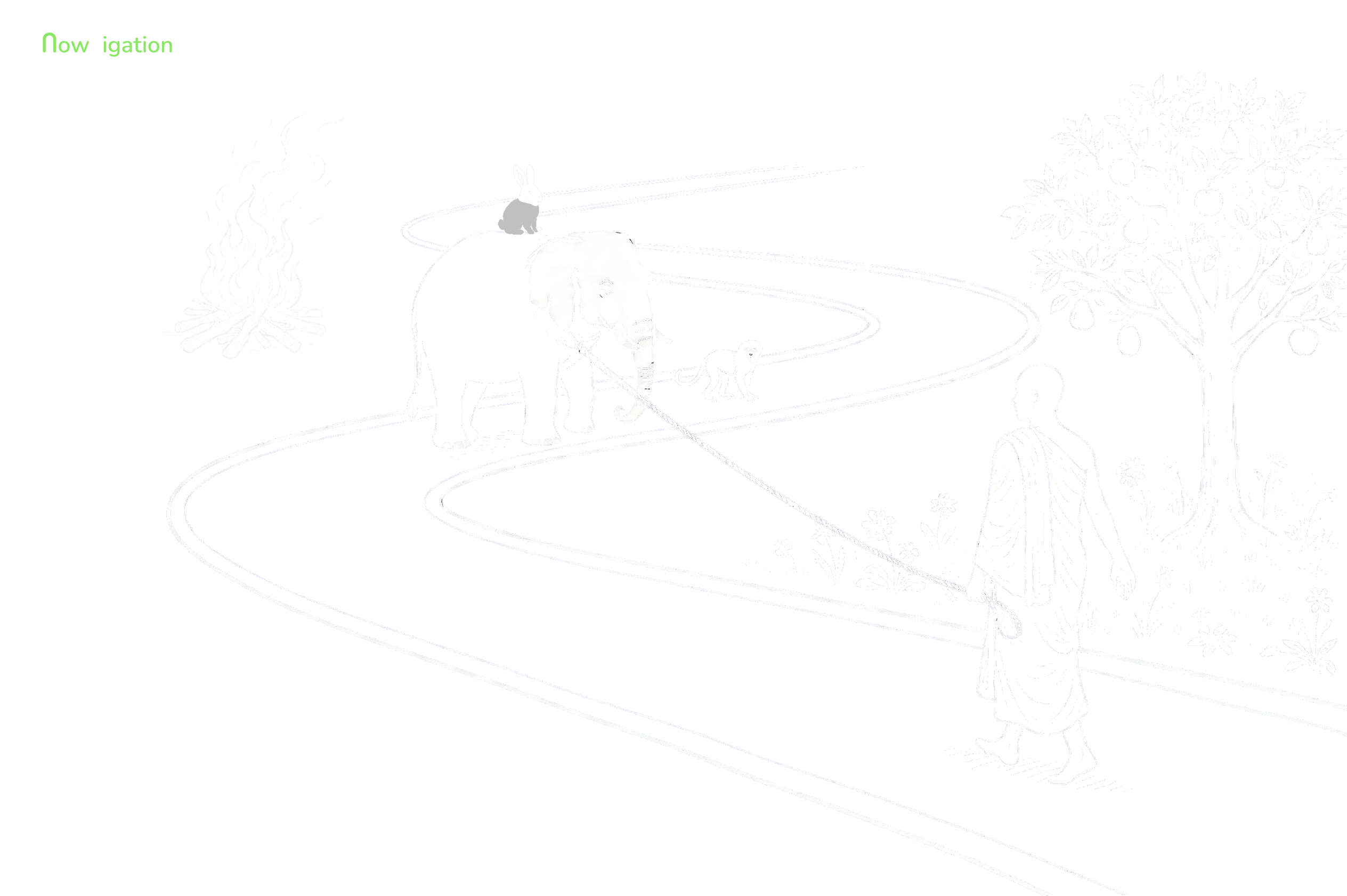
The third painting shows a far more dramatic change. For the first time in the series, something connects the monk to the elephant: a rope. The rope that the monk had been holding in his hand since the first painting - has finally caught.
The elephant has turned around. The monkey has turned around. Both are looking at the monk. For the first time, they acknowledge that he exists.
But there is something else in this painting. Something completely new that wasn't there before: a small rabbit appears on the elephant's back. Why is it there? What does it symbolize? We'll get to that.
What Happened Between the Second Painting and the Third?
In the second painting, the force that drove the meditator was the Power of Contemplation - he returned to the instructions again and again until he began to internalize them.
In the third painting, something has taken root. The meditator no longer just thinks about the instructions - he remembers them in real time. The moment attention escapes, he notices it and brings it back immediately. The force driving him now is called the Power of Mindfulness (Sanskrit: smṛtibala).
This is the difference between someone who knows the rules of driving, and someone who can actually drive. In the second painting we were still learning. In the third painting we have started to drive.
The Rope Catches - What Does It Actually Mean?
The central point of the third painting is the rope. The monk has been holding it since the first painting - but only now has he managed to throw it and catch. One end of the rope is now in his hand, and the other is wrapped around the elephant's trunk.
This is not an aesthetic symbol. It is a precise description of what happens in meditation at this stage.
In the first and second stages, attention would escape, and we would discover it only after a minute, two, five. "Wait, when exactly did I stop paying attention to the breath? I don't remember."
In the third stage something has changed: we notice immediately when attention escapes. Not after a minute. In that very second. And this is exactly the name of the third stage - "Resettling the Mind" (also known as Repeated Attention or Sanskrit: avasthāpana). The ability to bring attention back again and again, immediately, the moment it escapes.
The Elephant and the Monkey Turn Around - A Moment of Recognition
Notice another subtle detail: the elephant and the monkey have turned around. In the first and second paintings, they fled forward, their backs to the monk. They didn't even know he existed.
Now, for the first time, there is eye contact between them.
This is one of the most beautiful moments in the meditation journey. For the first time, we notice what we are thinking about. This is meta-cognition - attention that observes thinking itself.
The Rabbit - The New and Surprising Symbol
If you looked closely at the painting, you saw something that wasn't in the previous paintings: a small rabbit sitting on the elephant's back.
The rabbit is a very important traditional symbol, and it doesn't appear here for the first time by accident. The rabbit symbolizes Subtle Dullness - a particularly deceptive meditative state.
Here's what happens: in the third stage, the meditator finally manages to stay with the breath. There is quiet. There is stability. Thoughts hardly interfere. It seems as if everything is fine.
But something subtle may begin to happen - attention starts to become a little cloudy. Not fully awake. Like a radio that is dozing off. There is concentration - but it is loose. There is focus - but it is weak.
This is the great trap of the progression stage. Many meditators may think they have achieved ideal calm, that this state is deep meditation. "I'm so relaxed, I must really be making progress." Everything feels good. In reality, this is a new kind of distraction - a subtle dullness, a drowsy attention.
The rabbit, therefore, is a warning. It says: "Watch out. The moment thoughts calm down - see where your concentration is going. If it begins to dim - that is not progress. That is a new stage that must be overcome."
It is important to know: the rabbit does not disappear after this stage. It will accompany us through stage 5, and only in stage 6 will it disappear completely.
How Do We Recognize Subtle Dullness?
Three simple questions we can ask ourselves during practice:
1. Is the breath clear and sharp, or is it "smudged"?
2. Are we awake and fresh, or do we have a slight feeling of drowsiness?
3. Do we have motivation to practice, or are we just "sitting and waiting"?
If the first answer to each question is closer to the truth - we are in good concentration. If the second - the rabbit may have snuck onto the elephant's back.
What Hasn't Changed
Despite the impressive progress, two things have not changed:
The fire still burns strong - the effort required is still great. We still need to work hard to maintain concentration.
The fruit tree is still tempting - the five senses can still distract us. Concentration is good, but still fragile.
This reminds us: even at the third stage, the practice is still in the beginning stages. There are six more paintings. The path is still long.
This Stage in Real Life - What Does It Feel Like?
If in the second painting the progress was almost imperceptible, in the third painting it is already noticeable - but in a way different from what most people expect.
How will we know we are in the third stage?
We notice almost immediately when attention escapes - not after a minute. After a second or two. And we bring it back without drama.
Practice has become rhythmic - attention escapes, returns, escapes, returns. It doesn't bother us anymore. It's the rhythm.
There is a sense of longer silence - not minutes of silence, but certainly several dozen seconds in which truly nothing happens.
Watch out for the trap - if this silence begins to feel like drowsiness, if our motivation drops, if we "love" the state too much - the rabbit may have snuck in. We'll take a deep breath, open our eyes for a moment, and continue.
Why Is This Painting So Important?
If we had to choose one painting out of the nine that sums up the essence of meditation - it would be the third painting.
Why? Because this is where the real capacity is born. Not in the first painting, where we only began. Not in the ninth painting, where everything is already automatic. Right here, at this critical stage, the skill takes shape.
The third painting shows us three things:
1. There is a connection between the monk and attention. The rope doesn't just hold the elephant - it also teaches the monk that he can have influence. This is a moment of power.
2. We are noticing what we are thinking about. This may be the first time that we are paying attention to what we are thinking, and we can ask ourselves: Is this thought good for us? Is it useful? Did we choose to think it right now? A whole new world opens before us.
3. Meditation itself can contain a trap. The rabbit reminds us: every progression brings a new challenge. What worked before will not always be enough from now on.
The Nowvigation Method and the Third Stage
The third painting is the stage where the meditator begins to notice for himself, without guidance from someone else, how much time has passed since the start of practice and when his attention wandered. He is essentially becoming independent in practice. This is a critical stage, and precisely here the Nowvigation thumb mechanism becomes an especially precise tool. Why?
Because the rabbit is a trap that every meditator encounters. Moving the thumb in sync with the breath ensures that we don't fall into it. At this stage, some meditators may get frustrated with the need to move the thumb, feeling that it disturbs the quiet and tranquility. But in light of the rabbit trap, we can now look at this instruction in a completely different light - there is no longer any place to hide behind a "good feeling" that masks drowsiness.
The goal of Nowvigation is to prevent us from falling into the rabbit trap. After we reach stage 6, we will easily be able to give up moving the thumb in sync with the breath.
Three Takeaways
1. At the third stage, we begin to notice what we are thinking about. A new stage begins - a stage where we get the opportunity to decide and examine what we are thinking.
2. Subtle dullness is the silent enemy - the rabbit trap. The moment thoughts calm down, watch that alertness doesn't fall asleep with them. Silence is not the same as concentration.
3. Progress is measured by the ability to return, not by the ability to stay. No meditator, even at advanced stages, stays with attention forever. The difference is how quickly they return - and how willing they are to continue practicing this.
The next article in the series will deal with the fourth painting - when the elephant and the monkey become obedient for the first time, and the small rabbit refuses to leave.
Further reading: in the book "Pointing Out the Great Way" by Dan Brown, Wisdom Publications, one can find a detailed description of the nine stages of Shamatha (also spelled Samatha) according to the writings of Je Tsongkhapa.
Want to start practicing concentration with real-time feedback and identify which stage you are in? Download Nowvigation and begin your journey.