
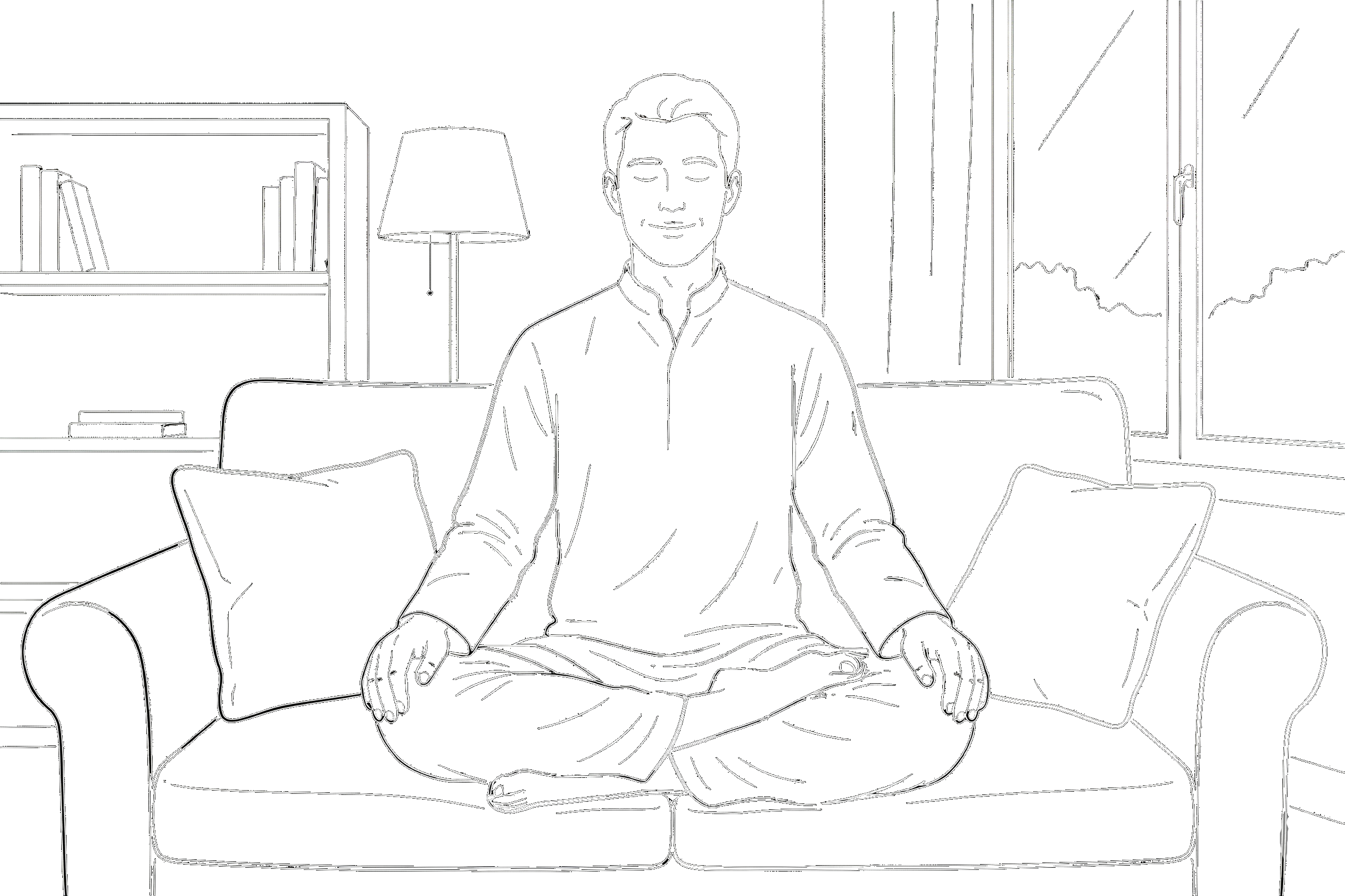
Meditation for Beginners: An Active Practice, Not a Passive Mood
How to Start Meditating Correctly - and Know You're on the Right Track
Many of us approach meditation with a strong desire to "advance" or "succeed." We live in an achievement-oriented environment where we are used to measuring everything by immediate results. But when it comes to training the mind, our usual metrics can mislead us.
In this article we will learn how to approach meditation the right way, how to deal with boredom and impatience, and what the real measure of your success is.
Am I doing it right? The definitive answer
This is the most common question among new practitioners. The answer is simple: if you can breathe, sit comfortably, and try to direct your attention to the breath - you are at a great starting point.
(Further reading: what is a breath anchor and why it matters)
It is important to understand two scenarios of success:
- Focus: You are aware of your breath. That is success.
- Noticing drift: You were not aware of your breath, but suddenly noticed your thoughts had wandered. The moment of noticing and returning attention is the ultimate workout for your attention muscle.
The less you judge the "quality" of your practice and the more self-compassion you bring, the more naturally the quality will improve.
"I don't have patience for this": controlling attention
The feeling of "I don't have patience" is completely natural. In an age of constant stimulation, our brains are used to seeking non-stop interest, so focusing on the breath can feel boring.
Here is the new perspective: controlling attention is no less critical than controlling your body. Imagine having no control over your hands - that would change your life. The willpower to practice meditation appears when we understand that this is the way to gain control over where our attention goes.
Building an internal "safety belt" without aids
Many people are used to practicing with relaxing music, and it is indeed more pleasant. But at Nowvigation we aim to build an internal safety belt that stays with you in daily life.
- Why without music? Music is like "training wheels." It is calming, but it does not build independent ability.
- The real-life advantage: When you learn to calm yourself on your own, that ability starts working automatically in everyday stressful situations. You will suddenly find that the meditation skill you built on the chair comes to your aid in the middle of a busy workday.
The most important rule: don't suffer along the way
The first minutes of meditation are the most challenging, because it takes time to slow down and settle in. But there is a clear rule: do not suffer.
(Further reading: why the first minutes are the hardest)
- Be flexible: If it is easier for you - close your eyes; if it is more comfortable - keep them open. There is no right or wrong.
- Ease up on yourself: If the mind is too stormy, spend a few minutes calming down before trying to focus on the breath.
- Consistency is the key: If you are suffering, you will not stick with it. So it is fine to challenge yourself, but never reach a state of suffering.
How to truly measure progress
In meditation, unlike other tasks, progress does not always look like a straight upward line. The difficulty level can change daily depending on the mental state you bring to practice.
The real measure of success is consistency. If you practiced every day - you are progressing, regardless of whether it felt easy or hard that day. The journey, the effort, and the consistency matter far more than how any single session felt.
(Further reading: how do you know meditation is working)
Why beginners quit
Without feedback, without structure, and without knowing if you are doing it right - most beginners quit within weeks. This is not a problem with the practitioner. It is a problem with the learning method. When there is no way to know if the practice is working, doubt takes the place of consistency.
What is different with Nowvigation
Thumb movement on the screen creates a physical anchor that connects body to attention. The app knows when the mind has wandered and gives immediate feedback - without waiting for you to notice on your own. This makes every practice session effective, even if the mind is noisy, even if it is your first day.
How long until you feel a change
Most practitioners report a change in the practice itself within two weeks of consistency - less struggle, more moments of natural quiet. The change in life itself - in arguments, under pressure, in the ability to listen - comes afterward, gradually, as the skill begins to work outside the cushion.
Ready to start building your own safety belt? Download Nowvigation and start practicing with a new perspective.